


Executive Summary
Article Highlights
The mistake many businesses make is viewing marketing as a series of disconnected tasks—running an ad here, writing a blog post there. But your customers don’t experience your brand in silos. They experience it as a continuous, overlapping journey.
If you want to fix leaks in your sales funnel and boost ROI, you need to understand that journey. You need a Customer Journey Map.
Here is your comprehensive guide to what customer journey mapping is, why it is critical for B2C survival, and how to align your entire digital strategy around it.
PART 1: The Essentials of Customer Journey Mapping
What Exactly is a Customer Journey Map?
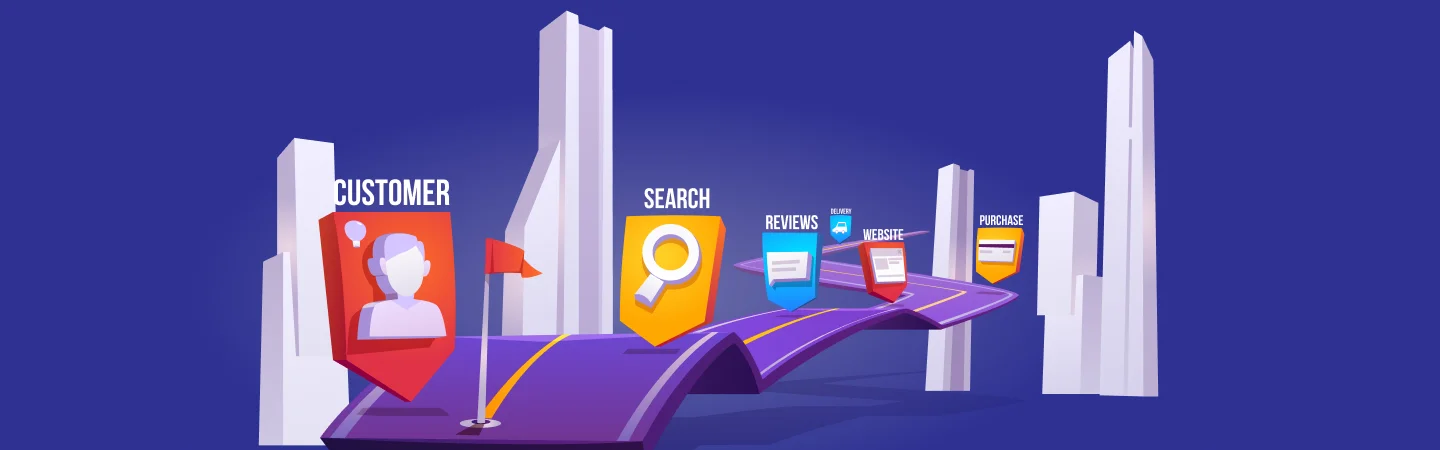
At its core, a customer journey map is a visual representation of every experience your customers have with you. It tells the story of their relationship with your brand, from the very first moment they realize they have a problem, through the purchase decision, and hopefully, into long-term loyalty.
Think of it not just as a timeline, but as an emotional graph. It doesn’t just track what they do; it attempts to track how they feel and what they are thinking at every step.
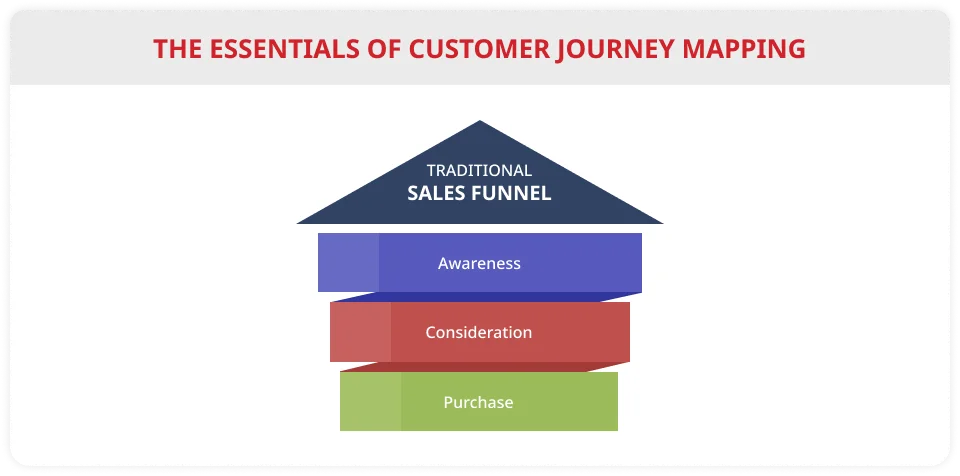
Moving Beyond the “Sales Funnel”
For years, marketers relied on the traditional “sales funnel”—a neat, linear path where people enter at the top and fall out the bottom as customers.
The modern B2C reality is messy. A customer might see an Instagram ad, forget about it, search on Google a week later, read a review on a third-party site, visit your website on mobile, abandon their cart, get a retargeting email, and finally buy on their desktop.
A journey map embraces this non-linear messiness, helping you identify where friction occurs.
Why Is This So Important for B2C Businesses?
If you aren’t mapping the journey, you are marketing based on assumptions. Here is why mapping is crucial:
1. Developing Empathy to Reduce Friction
You might think your checkout process is smooth. A journey map, backed by data, might reveal that 40% of mobile users drop off on the payment page because it’s confusing on a small screen. Mapping forces you to see your business through the customer’s eyes, highlighting painful obstacles you didn’t know existed.
2. Breaking Down Internal Silos
Often, the SEO team doesn’t talk to the social media team, and neither talks to customer support. A journey map aligns everyone around a single source of truth. It shows how an SEO-driven blog post connects to a social media retargeting campaign.
3. Improving Marketing ROI
By understanding which stages of the journey are weakest, you stop wasting money. Instead of throwing more budget at generic “brand awareness” ads, you might realize you need to spend that budget on “consideration” phase content instead.
PART 2: Mapping the Territory: Stages and Touchpoints
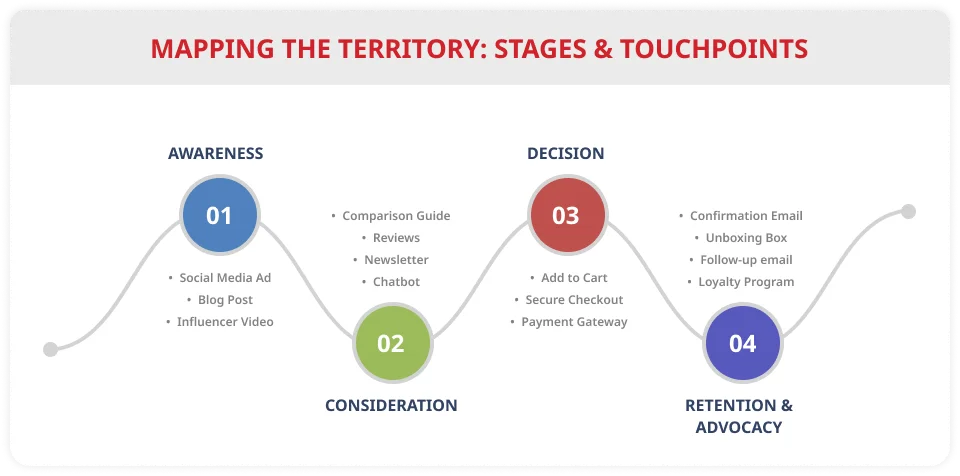
The Four Key Stages of the B2C Journey
Stage 1: Awareness (The “I have a problem” phase)
The customer realizes they have a need, but they don’t know you exist yet.
Goal: Be visible when they start looking for answers.
Stage 2: Consideration (The Research phase)
They know possible solutions exist and are comparing options. They are checking reviews, pricing, and features.
Goal: Prove why you are the best option and build trust.
Stage 3: Decision / Purchase (The Action phase)
They are ready to buy. They are on your site, wallet metaphorically in hand.
Goal: Make the transaction fast, easy, and reassuring.
Stage 4: Retention & Advocacy (The Relationship phase)
They have bought the product. Now, will they come back? Will they tell their friends?
Goal: Nurture loyalty and turn customers into fans.
Identifying Your Digital Touchpoints
A touchpoint is any interaction. In the digital world, these are vast. Here are common examples categorized by stage:
Awareness Touchpoints: Seeing a Facebook ad, reading an educational blog post found via Google search, seeing an influencer mention your product on TikTok.
Consideration Touchpoints: Visiting your “About Us” page, downloading a comparison guide, reading Google My Business reviews, interacting with your chatbot, signing up for a newsletter for a discount code.
Decision Touchpoints: The product page UX, the “add to cart” button, the checkout page flow, payment gateway options, shipping information clarity.
Retention Touchpoints: The transaction confirmation email, shipping update texts, unboxing experience, follow-up “how-to” emails, loyalty program emails, requesting a review.
PART 3: Optimizing Your Digital Strategy for the Journey
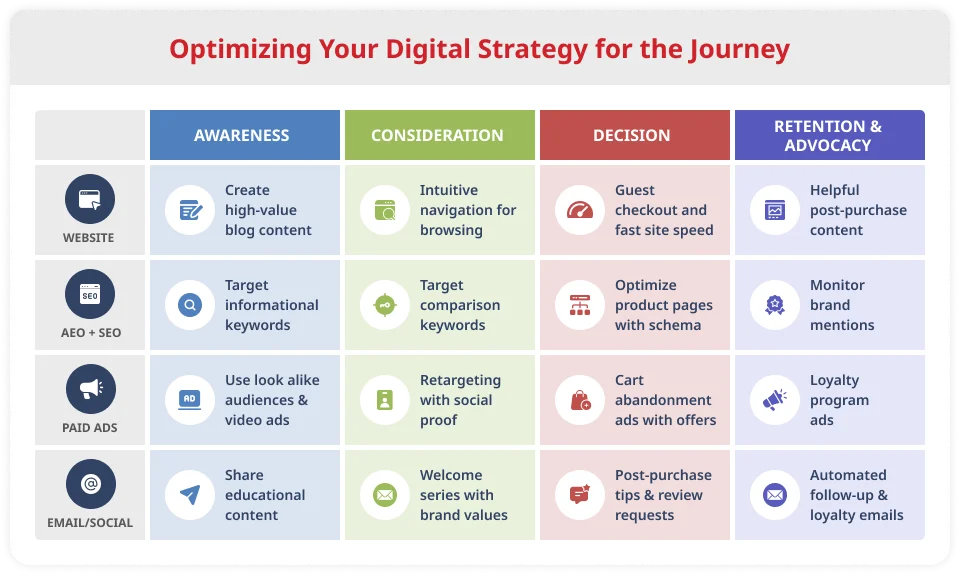
Once you have mapped the journey and identified the touchpoints, it’s time for action. You must align your digital channels to serve the customer’s mindset at each specific stage.
Here is how to optimize key digital activities:
1. Optimizing Your Website (The Hub)
Your website isn’t just a store; it’s a journey facilitator.
- For Awareness/Consideration: Create high-value blog content that answers beginner questions without a hard sell. Ensure navigation is intuitive so they can easily move from learning to browsing products.
- For Decision: Reduce friction ruthlessly. Guest checkout is mandatory. Ensure site speed is blazing fast. Display security badges and clear return policies right near the “Buy” button to ease last-minute anxiety.
2. Optimizing SEO (Search Engine Optimization)
SEO is not just about high-volume keywords; it’s about intent.
- Top of Funnel (Awareness): Target informational keywords like “How to fix [problem]” or “Best jeans for [body type].” Create comprehensive guides that rank well.
- Middle/Bottom of Funnel (Consideration/Decision): Target transactional keywords like “[Your Product] vs [Competitor Product]” or “Buy [Product Name] online.” Optimize product pages with rich schema markup so pricing and reviews show up in Google search results.
3. Optimizing Paid Ads (PPC and Social)
Stop showing the same generic ad to everyone. Use paid media to nudge people to the next stage.
- The Awareness Ad: Use lookalike audiences on Meta (Facebook/Instagram) to target people similar to your current customers with engaging video ads focusing on the problem you solve.
- The Retargeting Ad (Consideration): If someone viewed a product category but didn’t view a specific product, serve them ads showcasing your bestsellers in that category with social proof (testimonials).
- The Cart Abandonment Ad (Decision): This is crucial. If they left something in the cart, serve highly specific ads reminding them, perhaps offering a limited-time 10% discount to push them over the line.
4. Optimizing General Digital Marketing (Email & Social)
Use these channels to build relationships, not just blast offers.
- Email Marketing: Don’t just send a weekly newsletter. Create automated flows triggered by behavior.
- Welcome Series (Consideration): Introduce your brand values.
- Post-Purchase Series (Retention): Send helpful tips on how to use the product before asking for a review.
- Social Media: Use social channels for more than just broadcasting. Use them for listening. What questions are customers asking in comments? Use those insights to refine your Awareness stage content.
Conclusion
FAQ
1. What is B2C customer journey mapping?
2. What are the main stages of a B2C customer journey?
The four key stages are:
- Awareness – The customer discovers the brand.
- Consideration – They evaluate options and compare solutions.
- Decision – They choose and convert.
- Retention & Advocacy – They return, engage, and recommend.
Each stage requires different content, messaging, and channel alignment.
3. Why is customer journey mapping important for B2C businesses?
4. How does journey mapping improve conversion rates?
5. What are examples of B2C touchpoints?
Common touchpoints include:
- Google search results
- Paid social ads
- Landing pages
- Email campaigns
- Product pages
- Reviews
- Customer support interactions
Consistency across these touchpoints increases trust and conversion probability.
6. How do paid media campaigns fit into customer journey mapping?
Paid media supports different journey stages:
- Awareness ads introduce the brand.
- Consideration campaigns retarget and educate.
- Decision-stage ads push offers and urgency.
- Retention campaigns promote loyalty and upsells.
Recent Posts
Mastering the Invisible Click: A Practical Guide to Zero-Click Search Optimization
Mastering the Invisible Click: A Practical Guide to Zero-Click Search Optimization
Stop the Leaks: The Ultimate 22-Point Checklist for a High-Converting Landing Page
Stop the Leaks: The Ultimate 22-Point Checklist for a High-Converting Landing Page