






Executive Summary
Article Highlights
In today’s crowded online world, just being “seen” isn’t enough to succeed. Thousands of brands are all shouting for the same few seconds of your customer’s attention. To turn that brief moment of interest into a real, lasting relationship, you need two things working together: Your Values (the “how” & “why” you do what you do) & The Customer’s Path (the “where” & “when” they find you).
When you match your core principles with exactly how a customer feels in the moment, you stop being “just another noisy ad” and start becoming a brand that people actually trust and value.
Part 1: Fix Your Digital Marketing Strategy First
Before you spend a single dollar on ads, these four principles should be baked into everything you do. Think of them as the DNA of your brand.
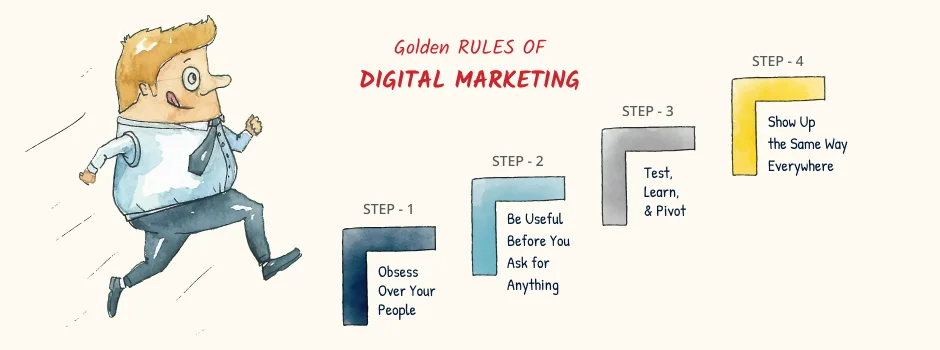
1. Obsess Over Your People
Marketing isn’t about what you want to say; it’s about what your customer needs to hear. To do this well, you have to look past basic facts like their age or city. You need to understand their hopes, their fears, and the specific problems they are trying to solve when they go looking for help.
2. Be Useful Before You Ask for Anything
We live in an era where everyone is tired of being sold to. The only way to get your foot in the door is to offer value first. Whether it’s an educational post, a free tool, or just an entertaining video, you must give something of worth before you ever ask someone to open their wallet.
3. Test, Learn, and Pivot
The internet is basically a giant laboratory. Every time someone clicks (or doesn’t click), they are giving you a clue. Instead of sticking to a rigid, boring plan for the whole year, use those clues to see what’s working in real-time. If something flops, change it. If something works, do more of it.
4. Show Up the Same Way Everywhere
A customer might see your post on Instagram, read a review on a different site, and then finally visit your website. If you sound like a different person or offer a different deal at each of those stops, you’ll lose their trust instantly. Keeping a consistent voice and message makes you feel reliable.
Part 2: Mapping the User Journey
The user journey is the narrative arc of a customer’s relationship with your brand.

Phase 1: Awareness (Discovery)
- The User’s Goal: Identifying a problem or seeking inspiration.
- The Strategy: Broad reach and education.
- Tactics: SEO, social media content, and high-level “How-To” guides.
Phase 2: Consideration (Evaluation)
- The User’s Goal: Comparing options and weighing pros/cons.
- The Strategy: Establishing authority and building trust.
- Tactics: Case studies, webinars, and detailed whitepapers.
Phase 3: Decision (Conversion)
- The User’s Goal: Minimizing risk and finalizing the purchase.
- The Strategy: Removing friction and offering incentives.
- Tactics: Free trials, testimonials, and simplified checkout processes.
Phase 4: Retention & Advocacy (Loyalty)
- The User’s Goal: Maximizing the value of their purchase.
- The Strategy: Transforming a customer into a “fan.”
- Tactics: Loyalty programs, personalized support, and referral rewards.
Part 3: Bridging the Gap (Implementation)

The real magic happens when you apply a Tenet to a Journey Stage. For example, applying “Personalization” (Tenet) to the “Consideration Stage” (Journey) might involve sending a customized email to a user who spent five minutes looking at a specific service page but didn’t book a call.
Part 4: Takeaway
| Trust is the Foundation | Value-led content at the Awareness stage builds the trust necessary for the Decision stage. |
|---|---|
| Data > Opinion | Never guess what the user wants; use A/B testing & heatmaps to let their behavior guide your design. |
| Friction is the Enemy | Every extra click in the Decision stage reduces your conversion rate significantly |
| The Journey is Non-Linear | Users often jump back & forth between stages; your marketing must be flexible enough to meet them whenever they land. |
| Advocacy is the Ultimate ROI | A referred customer has a significantly higher lifetime value and lower acquisition cost than a cold lead. |
Why Running Ads Without Strategy Fails
- Lack of audience clarity
- Undefined value proposition
- No conversion pathway
- Misaligned campaign objectives
What a Strong Paid Media Strategy Includes
Audience Intelligence
- Intent levels
- Awareness stages
- Buying triggers
Offer & Messaging Alignment
- Value-first positioning
- Problem-solution framing
- Message-market fit
Funnel & Conversion Architecture
- Landing page alignment
- Conversion tracking setup
- Retargeting logic
Strategy Framework Before You Launch Your First Ad
Step 2: Map customer journey
Step 3: Validate offer with organic traffic or small test budgets
Step 4: Establish tracking & KPIs
Signs You’re Ready to Scale Paid Ads
- Define Business Objective
- Identify Ideal Customer Profile
- Align Offer and Messaging
- Conversion benchmark established
- Data-driven iteration loop
FAQ
1. Why do most first paid ads fail?
2. What should you fix before running your first ad?
Before launching your first ad, you should clarify:
- Your ideal customer profile (ICP)
- The core problem you solve
- Your value proposition
- The conversion goal (lead, sale, booking)
- Tracking and analytics setup
A structured paid advertising strategy ensures that traffic converts instead of bouncing.
3. How do you create a paid media strategy that converts?
A converting paid media strategy includes:
- Audience research based on intent and behavior
- Message-market fit validation
- Funnel mapping across awareness stages
- Conversion tracking implementation
- Budget allocation based on performance data
Strategy-first execution improves ad ROI and scalability.
4. Is it better to test organically before running paid ads?
5. How much budget should you spend on your first ad campaign?
There is no universal number. Budget should depend on:
- Your industry competition
- Customer acquisition cost benchmarks
- Conversion rate expectations
- Testing timeline
Instead of focusing on budget alone, focus on conversion architecture and strategic planning to avoid wasted ad spend.
6. What are the signs you’re ready to scale paid ads?
You’re ready to scale when you have:
- A clearly defined target audience
- Proven messaging with measurable engagement
- A conversion-optimized landing page
- Reliable tracking and attribution
- Early positive ROI data
Scaling without these foundations leads to diminishing returns.
7. What is the biggest mistake in paid advertising?
Recent Posts
Mastering the Invisible Click: A Practical Guide to Zero-Click Search Optimization
Mastering the Invisible Click: A Practical Guide to Zero-Click Search Optimization
Stop the Leaks: The Ultimate 22-Point Checklist for a High-Converting Landing Page
Stop the Leaks: The Ultimate 22-Point Checklist for a High-Converting Landing Page